The One-Year Rule and Other Decluttering Methods That Actually Work for Reach-In Closets
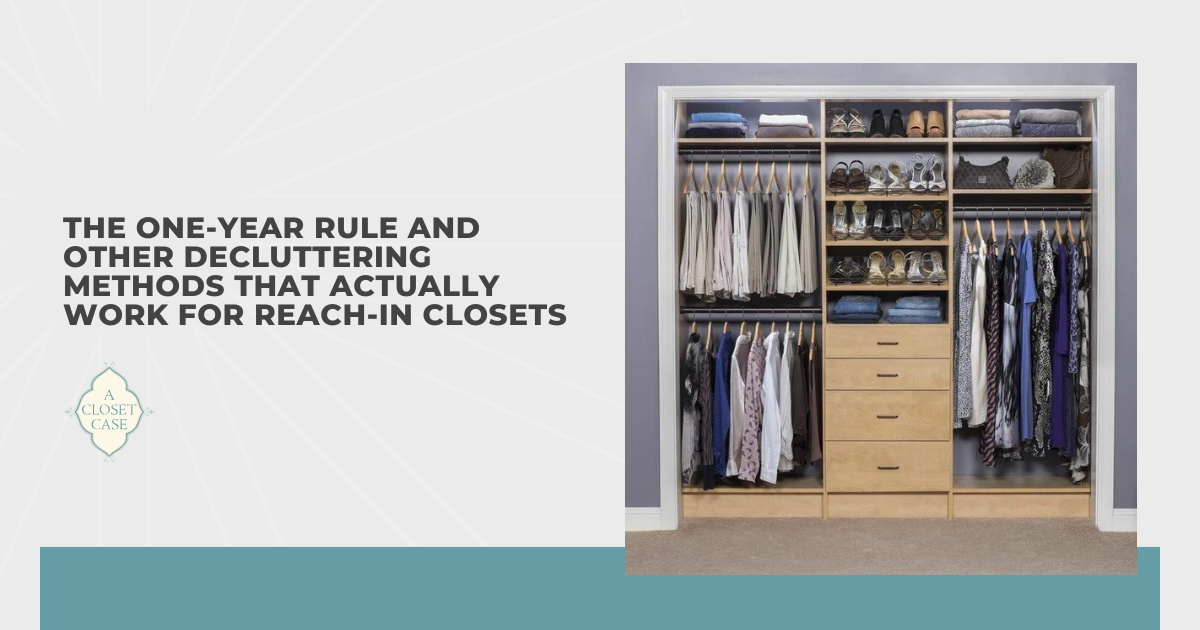
Most people don't realize how much a reach-in closet is working against them until they're standing in front of it, running late, and can't find what they're looking for. The limited depth, the narrow opening, and the single rod that somehow has to hold an entire wardrobe create a setup that punishes accumulation faster than any other storage space in the home. And yet, the answer isn't always a bigger closet. More often than not, it's a better system for deciding what actually belongs in the one you already have.
Decluttering a reach-in closet isn't about being ruthless or adopting a minimalist lifestyle you don't actually want. It's about making deliberate decisions, and having a method that takes the guesswork out of those decisions is what makes the difference between a one-time cleanout and a closet that stays manageable long term. Having helped homeowners tackle everything from overflowing reach-in closets to full custom storage overhauls, I've seen firsthand which methods actually stick and which ones sound good in theory but fall apart in practice.
Here are the decluttering methods worth knowing about and how to make each one work specifically for your reach-in closet:
- One-year rule
- Reverse hanger method
- Four-box method
- KonMari method
- 20/20 rule
- Seasonal rotation
Not every method will suit every person, but understanding how each one works is the first step toward finding the approach that'll actually stick for you.
One-Year Rule
The one-year rule is one of the most straightforward decluttering frameworks out there, and it's a good place to start because it removes a lot of the emotional weight from the decision-making process. The premise is simple: if you haven't worn or used something in the past 12 months, it's a strong signal that you probably don't need it. No complicated criteria, no lengthy deliberation. Just an honest look at what's actually been getting used and what's just been taking up space.
Where it works best is with everyday clothing: tops, bottoms, casual wear, and the kind of pieces that cycle in and out of regular rotation throughout the year. If a full 12 months have passed and something hasn't made it off the hanger, that's a pretty clear indication it's not serving your wardrobe the way you thought it would when you bought it. In a reach-in closet where every inch of rod space counts, that kind of clarity is genuinely useful.
That said, the one-year rule isn't a perfect fit for every category. Occasion wear is the most obvious exception. A dress worn to one wedding and nothing else in the past year isn't necessarily a candidate for the donate pile, it's just a piece with a specific purpose and a low frequency of use. The same logic applies to items tied to a hobby, a season, or a life stage you're still in. Sentimental pieces are another category worth handling separately rather than forcing through the same twelve-month filter.
The most practical way to apply it in a reach-in closet is to go category by category rather than trying to assess everything at once. Work through your tops, then your bottoms, then your outerwear, and so on. It's a slower approach, but it's far less overwhelming than pulling everything out at once and trying to make decisions under pressure. What I've noticed working with homeowners on this is that breaking it down by category also makes it much easier to spot patterns, like realizing you own 14 black t-shirts, six of which you never reach for.
Reverse Hanger Method
Behavior is a more reliable decluttering tool than memory, and that's exactly what the reverse hanger method taps into. At the start of the process, flip every hanger in your closet so that it faces the opposite direction. Each time you wear something and put it back, hang it the normal way. After a set period of time, typically three to six months, whatever is still facing the wrong way tells you exactly what you haven't touched.
What makes this method particularly valuable in a reach-in closet is that it works within the space rather than requiring you to empty it out first. There's no big dramatic overhaul, no afternoon blocked off, and no pile of clothes taking over the bedroom floor. It runs quietly in the background while you go about your normal routine, and from what I've seen, the data it collects is far more reliable than trying to remember what you've worn over the past year based on gut feeling alone.
The results can be genuinely surprising. Most people have a working theory about which pieces they wear regularly and which ones they don't, but the reverse hanger method has a way of exposing the gap between what we think we wear and what we actually reach for. It's not uncommon to discover that a significant portion of a reach-in closet is occupied by clothing that hasn't been touched in months, pieces that felt essential at purchase but quietly faded into the background.
The one limitation worth being honest about is that it doesn't work for folded items, shoes, or accessories. It's strictly a hanging wardrobe tool. For everything else in the closet, you'll need to pair it with another method from this list to get a complete picture of what's earning its place and what isn't.
Four-Box Method
When the decision-making process feels overwhelming, having a clear physical structure to work within makes a significant difference. Before you start, set out four boxes or bags and label each one with a category: Keep, Donate, Toss, and Relocate. Every single item you pick up gets assigned to one of those four boxes without exception. There's no putting things back without making a decision first, and that constraint is precisely what makes the method so effective.
The Keep, Donate, and Toss categories are fairly self-explanatory, but the Relocate box is the one most people skip and the one that does the most work in a reach-in closet specifically. Not everything that's taking up space in your closet actually belongs there. Sports equipment, extra towels, gift wrapping supplies, and random items that migrated in over time all qualify as relocation candidates. Moving them to a more appropriate spot in the home frees up prime closet real estate without requiring you to get rid of anything at all.
Working through a reach-in closet with the four-box method is most manageable when you tackle it zone by zone rather than all at once. Start with the hanging section, then move to shelves, then the floor, then any drawers or bins. Keeping the scope contained to one zone per session prevents the kind of decision fatigue that leads to everything ending up back where it started.
What happens immediately after the session ends matters just as much as the session itself. A Donate box that sits in the corner of the room for two weeks has a way of getting picked through and refilled, and a toss box that doesn't make it to the bin invites second-guessing. Both need to leave the space within a day or two of the session wrapping up, because that's what separates a productive declutter from one that quietly unravels before it has a chance to stick.
KonMari Method
Of all the decluttering frameworks that have gained mainstream attention over the past decade, the KonMari method is probably the most talked about and the most misunderstood. Developed by Marie Kondo, the method is built around a single guiding question: does this item spark joy? If it does, it stays. If it doesn't, it goes. It sounds deceptively simple, but the philosophy behind it runs deeper than the question itself. It's about developing a more intentional relationship with your belongings rather than just editing them down by volume.
Where the KonMari method genuinely shines is with clothing and personal accessories, which makes it a reasonable fit for a reach-in closet context. Holding a piece of clothing and assessing how it makes you feel is a surprisingly effective way to cut through the ambiguity that stalls most decluttering sessions. It bypasses the practical justifications we tend to make for keeping things we don't actually love and forces a more honest response.
The complications tend to show up with practical items and work clothing. It's hard to apply a joy-based filter to a uniform, a pair of steel-toed boots, or the rain jacket you only reach for three times a year but genuinely need when you do. Shared closet spaces add another layer of complexity, since one person's joy threshold rarely matches the other's. In these cases, the method works better as a guiding principle than a strict rule, using the joy question as a starting point rather than the final word on every decision.
Adapting it for a reach-in closet also means being realistic about the method's signature first step, which involves emptying the entire category before assessing any of it. In a smaller space, pulling every item of clothing out at once can feel more paralyzing than productive. A modified approach that works through the closet section by section preserves the spirit of the method while keeping the process from becoming an all-day project that never quite gets finished.
20/20 Rule
Most closets have a category of clutter that's genuinely hard to declutter, not because the items are meaningful or frequently used, but because letting them go feels wasteful. A spare phone charger that might come in handy, a belt that doesn't quite fit but cost good money, a jacket that's seen better days but could theoretically be worn again. These are the items that survive every decluttering session by default, not because they've earned their place but because nobody wants to make the call on them. The 20/20 rule exists specifically for this category.
The premise is straightforward. If an item can be replaced for under $20 and sourced again in under 20 minutes, it's safe to let it go. The rule works by shifting the mental framing around disposal. Instead of asking whether you might need something someday, it asks whether the cost and effort of replacing it would actually be that significant. For most of the low-grade clutter sitting in a reach-in closet, the honest answer is no.
What I find most useful about this rule is the way it quietly dismantles the "just in case" mindset that keeps so many closets stuck in a state of permanent overflow. Holding onto things for hypothetical future scenarios is one of the most common drivers of closet clutter, and the 20/20 rule gives you a practical way to challenge that instinct without feeling reckless about it.
Where it has limitations is with items that are harder to replace than they appear, things that are discontinued, require a specific fit, or belong to a category where quality varies significantly. In those cases, a straightforward cost-and-availability check isn't quite enough, and it's worth applying a different method alongside it to make a more complete assessment.
Seasonal Rotation
Twice a year, most people pull out their off-season clothing, swap it with what's currently in the closet, and move on without giving it much more thought than that. Treated as nothing more than a storage task, seasonal rotation is a missed opportunity. Approached with a little more intention, it becomes one of the most effective ongoing decluttering tools available, especially for a reach-in closet where pressure on available space never really lets up.
At the change of each season, clothing that's going out of rotation deserves a quick review before it gets packed away. This is the natural moment to apply the one-year rule, check the reverse hanger data if you've been running that experiment, or simply ask whether each piece is still earning its place in the wardrobe. Catching items at this transition point is far less overwhelming than doing a full closet audit from scratch, because the scope is already limited to one season's worth of clothing at a time.
Arguably the biggest advantage of seasonal rotation as a decluttering strategy is that it builds the habit of regular review into the calendar without requiring any extra motivation to get started. The swap needs to happen regardless, so the assessment happens alongside it. Over time, this rhythm prevents the slow accumulation that turns a manageable reach-in closet into an overwhelming one, because nothing gets the chance to sit untouched for years without eventually coming up for review.
Packing away seasonal pieces properly matters just as much as the decluttering itself. Breathable bins, vacuum bags for bulkier items, and dedicated shelf space outside the main closet all free up the reach-in closet to function at its best for whichever season you're currently in. A closet that only holds what's relevant right now is a closet that's genuinely easy to use every single day.
Conclusion
No single decluttering method works for everyone, and that's not a flaw in any of these frameworks. It's just a reflection of the fact that wardrobes, habits, and lifestyles are different from person to person. Some people need the behavioral data of the reverse hanger method before they can make confident decisions. Others need the structured simplicity of the four-box method to keep the process from feeling paralyzing. The best approach is usually the one that matches how you naturally think and make decisions, because that's the one you'll actually follow through on. What all of these methods have in common is that they work best when they're paired with a reach-in closet that's set up to support the wardrobe that's left behind, because decluttering creates the opportunity, but a storage system that's built around your actual needs is what makes it last.
Showroom Location
260-D Seven Farms Drive, Daniel Island, SC 29492
Contact Information
Phone: (843) 971-9069
Email: aclosetcase@gmail.com
Hours
Showroom & Office Hours
Monday - Friday: 9:00 AM - 5:00 PM
Saturday - Sunday: By Appointment Only